
Chapter 2
The Psychology
Jung, Campbell, Estés, and why a picture can feel like it knows you.
Carl Jung and the archetypes
You don't need to believe in magic to find tarot useful. Carl Jung, the Swiss psychiatrist, gave us a rational framework for this. He proposed the 'collective unconscious.' This is a shared pool of human experiences and symbols that we all inherit. He called these universal patterns archetypes. Think of them as mental blueprints. They aren't specific people, but roles we all recognize: the Mother, the Father, the Trickster, the Sage. Tarot cards are essentially a visual library of these archetypes. When you pull the Empress, you aren't seeing a psychic prediction. You're seeing the archetype of abundance and nurturing. When the Tower appears, it's the archetype of sudden collapse and necessary change. These images trigger something deep in your brain because they mirror the human condition.
Jung believed that we spend our lives trying to integrate these different parts of ourselves. He called this process 'individuation.' By looking at a card, you're not asking a deck for the future. You're using a symbol to bring a hidden part of your psyche into the light. It's a mirror, not a crystal ball.
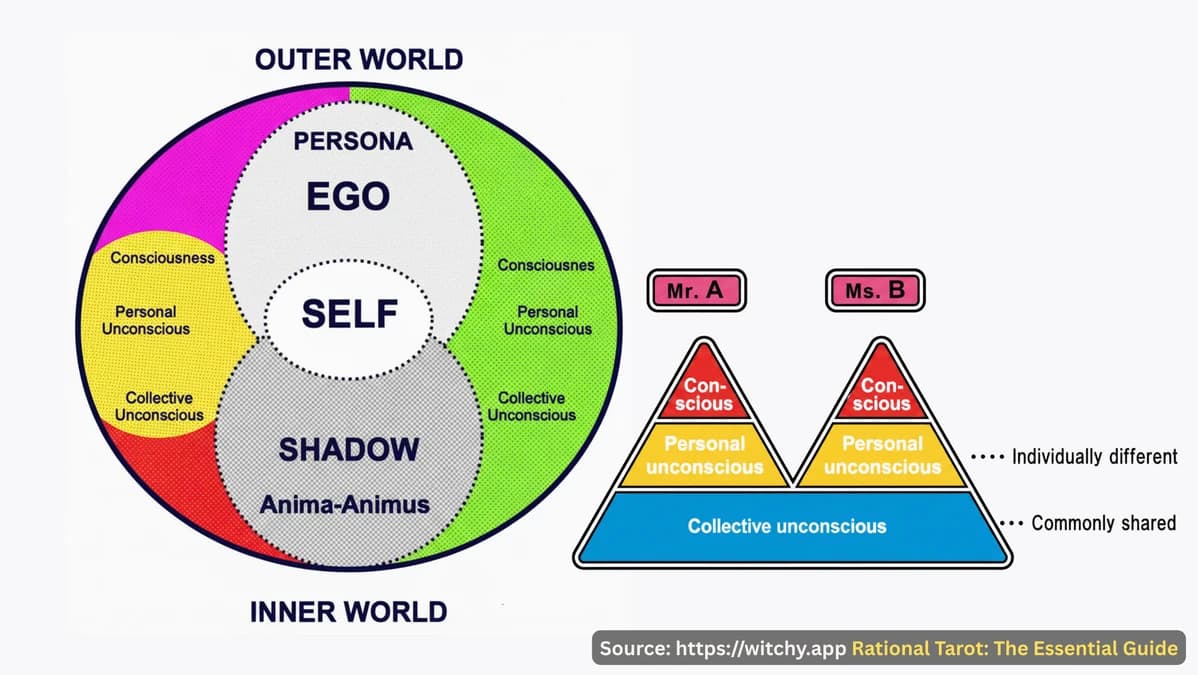
When you see a card that feels 'wrong' or irritating, that's where the real work starts. Jung called this the 'Shadow.' The Shadow contains the traits we deny or dislike. If the Devil card makes you uncomfortable, it's likely because it's pointing to a desire or a fear you've pushed aside. Recognizing the archetype allows you to name the feeling and manage it. This process is called synchronicity. Jung noticed that meaningful coincidences happen. You think of a problem, and you pull the exact card that mirrors it. This isn't a miracle. It is your mind projecting its internal state onto the card. The card acts as a hook. It catches a thought you were too afraid to voice and pulls it into the open. Take the Magician. He represents the archetype of the Will. If you feel stuck, this card doesn't "give" you power. It reminds you that you already have the tools. It prompts you to stop waiting and start acting. You aren't reading the cards. You are reading yourself through the cards.
Joseph Campbell and the hero's journey
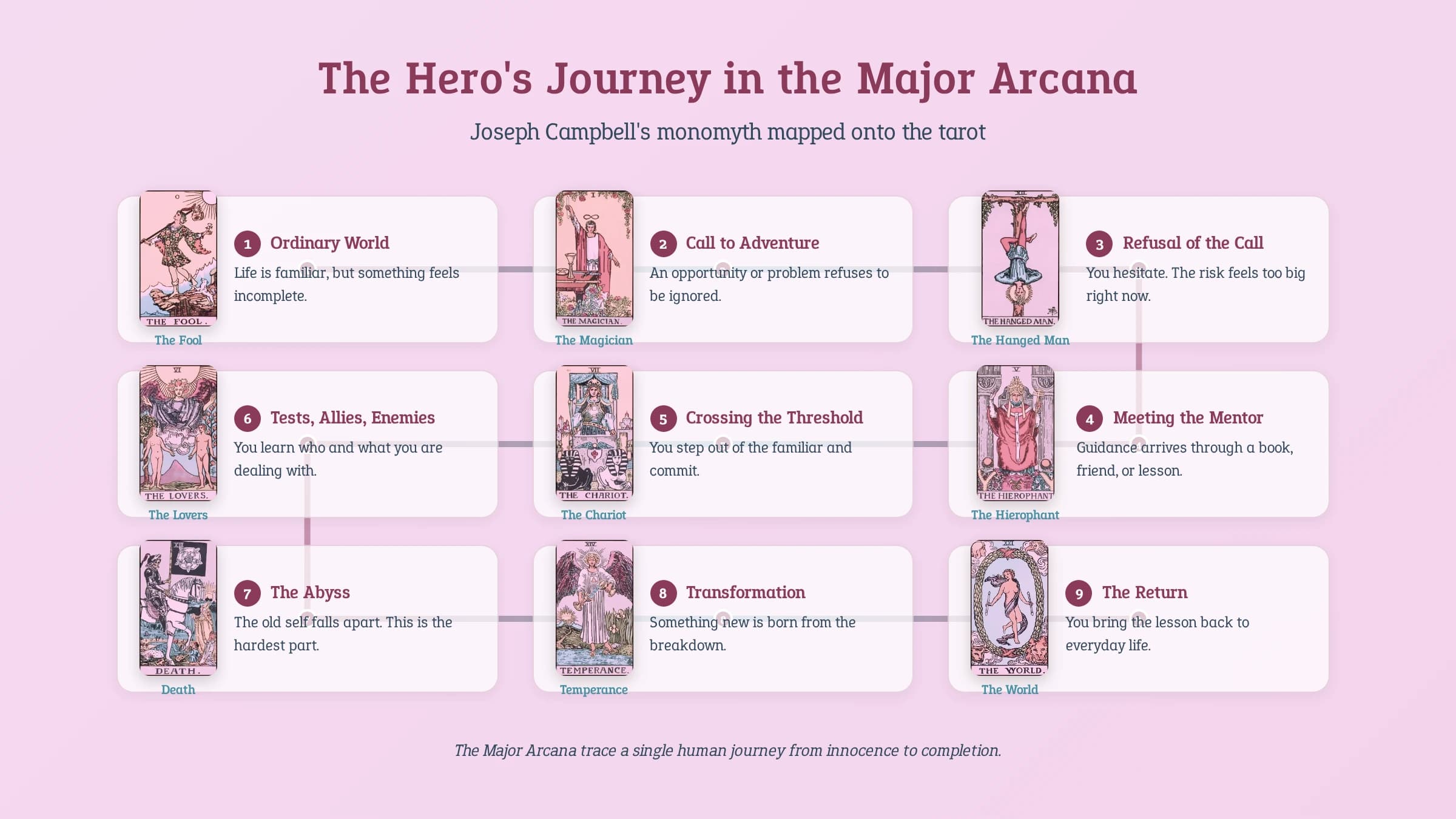
Joseph Campbell studied myths from every corner of the globe. He found that almost every culture tells the same story. He called it the Monomyth or the Hero's Journey. This isn't just about slaying dragons. It's a metaphor for growing up and facing the unknown. The journey usually follows a pattern: the call to adventure, the crossing of the threshold, the ordeal, and the return with a gift. Tarot follows this same narrative arc. The Major Arcana is a map of this journey. The Fool starts at zero. He's the innocent who steps off the cliff. As he moves through the cards, he encounters mentors like the Hierophant and challenges like the Moon. He's not just moving through a deck; he's moving through the stages of human development.
Think of the Tower card as the "abyss" in Campbell's work. It is the moment the old self dies so a new one can emerge. You cannot reach the Star or the Sun without first enduring the crash. This mirrors the classic myth of the descent. The hero must go into the dark to find the light. In your reading, the Tower isn't a tragedy. It is the necessary demolition of a false foundation. This cycle repeats throughout your life. You don't just complete the journey once. You move through it in waves. A career change is a call to adventure. A breakup is a crossing of the threshold. Each cycle leaves you with a "boon," or a lesson, that you carry into the next phase. You become the mentor for someone else. Most of us feel stuck in our lives. We feel like we're in the belly of the whale or facing an impossible gatekeeper. By mapping your current situation onto the Hero's Journey, you gain perspective. You realize that struggle isn't a sign of failure. It's a required step in the process. The pain is part of the plot. Campbell argued that myths are public dreams. Tarot is a private way to engage with those myths. When you layout a spread, you're essentially writing a storyboard for your own life. You can see where you are in the cycle and what the next logical step is. It turns a chaotic mess of emotions into a structured story you can actually navigate.
Clarissa Pinkola Estés and Women Who Run with the Wolves
Psychology isn't just about logic. It's about the wild, intuitive parts of the mind. Clarissa Pinkola Estés explores this through the 'Wild Woman' archetype. She argues that modern society tames our instincts. This leaves us feeling numb or disconnected. She uses folklore and storytelling to help people reclaim their primal nature. In tarot, this energy lives in cards like the High Priestess or the Strength card. These aren't about passive waiting or brute force. They're about wild intelligence. It is the gut feeling that tells you something is wrong before your brain can explain why. Estés teaches us that instincts are a form of knowledge.
When we ignore these instincts, we experience psychic starvation. We become overly reliant on rules and expectations. Estés suggests we must 'run with the wolves' to find our authentic selves. This means embracing the messy, instinctive, and sometimes frightening parts of our nature. Think of the Moon card. It represents the dark forest where we lose our way. For Estés, this forest is where the soul hides its secrets. To find the truth, you must stop fearing the dark. You must trust your scent and your hearing over your sight. This is how you recover the lost pieces of your identity. Consider the Queen of Wands. She is the fire of the Wild Woman. She doesn't ask for permission to exist. She acts on impulse and passion. When this card appears, it is a call to stop overthinking. It is a nudge to trust your raw energy. Using tarot through this lens means looking for the wild answer. Instead of asking 'What will happen?', ask 'What is my instinct trying to tell me?' The cards act as a bridge between your rational mind and your primal self. They give you a safe language for things that don't fit into a spreadsheet.
Projection, narrative, and the talking cure
The real magic of tarot is actually a psychological phenomenon called projection. Projection happens when you attribute your own unconscious feelings to something outside yourself. If you are angry at your boss but cannot admit it, you might see a hostile card in a reading. You aren't seeing the boss's energy. You are seeing your own anger reflected back at you. This is why tarot works regardless of whether the cards have supernatural powers. They act as Rorschach inkblots. Your brain searches for patterns to make sense of random images. In doing so, it reveals what is already on your mind. You are not getting a message from the universe. You are getting a message from your own subconscious.
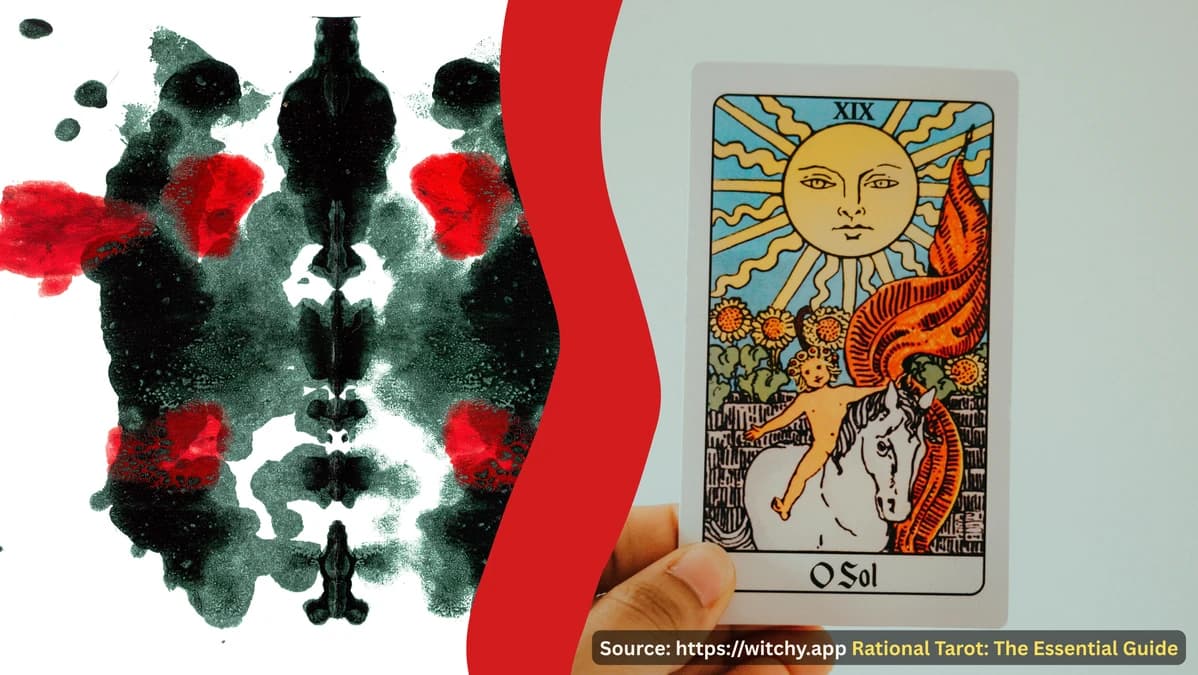
Consider the Three of Swords. To one person, it looks like heartbreak. To another, it looks like a necessary surgery to remove a toxin. The card doesn't change, but the viewer's internal state does. You bring the meaning to the table. The card just gives you a safe place to put it. This ties into what Josef Breuer and Bertha Pappenheim first called the talking cure, a concept Freud later developed. The act of verbalizing your thoughts helps you organize them. When you describe a card and how it relates to your life, you are externalizing your internal conflict. You move the problem from the confusing space of feeling to the clear space of language. By building a narrative around the cards, you stop being a victim of your circumstances. You become the narrator. You can change the story. If the current chapter of your life feels like a tragedy, the cards help you identify the plot points you can change. You are using a tool of projection to achieve a state of clarity. It is a rational way to handle irrational emotions.
Try it
Sources
- Jung, C. G. (1959). The archetypes and the collective unconscious (R. F. C. Hull, Trans.). Collected Works of C. G. Jung, Vol. 9, Part 1. Princeton University Press.
- Jung, C. G. (1960). The structure and dynamics of the psyche (R. F. C. Hull, Trans.). Collected Works of C. G. Jung, Vol. 8. Princeton University Press.
- Campbell, J. (1949). The hero with a thousand faces. Pantheon Books.
- Estés, C. P. (1992). Women who run with the wolves: Myths and stories of the wild woman archetype. Ballantine Books.
- Breuer, J., & Freud, S. (1895). Studies on hysteria (Standard Ed., Vol. 2). Hogarth Press.