
Chapter 1
The Math
Why a 78-card deck contains more possibilities than you can imagine.
The deck as a combinatorial space
Forget mysticism for a moment. Let's look at the deck as a set of data. A standard tarot deck has 78 unique cards. When you shuffle them, you aren't just mixing paper; you're creating a specific sequence. This sequence is one possible state out of a staggering number of options.
To find the total number of ways to arrange 78 cards, we use a factorial: 78!. That number is roughly 1.13 x 10^115. To put that in perspective, there are only about 10^80 atoms in the observable universe. Every time you shuffle a deck thoroughly, you've likely created a sequence of cards that has never existed before in human history. This massive scale is why tarot feels infinite. You aren't drawing from a small pool of outcomes. You're interacting with a combinatorial space so vast it defies human intuition.
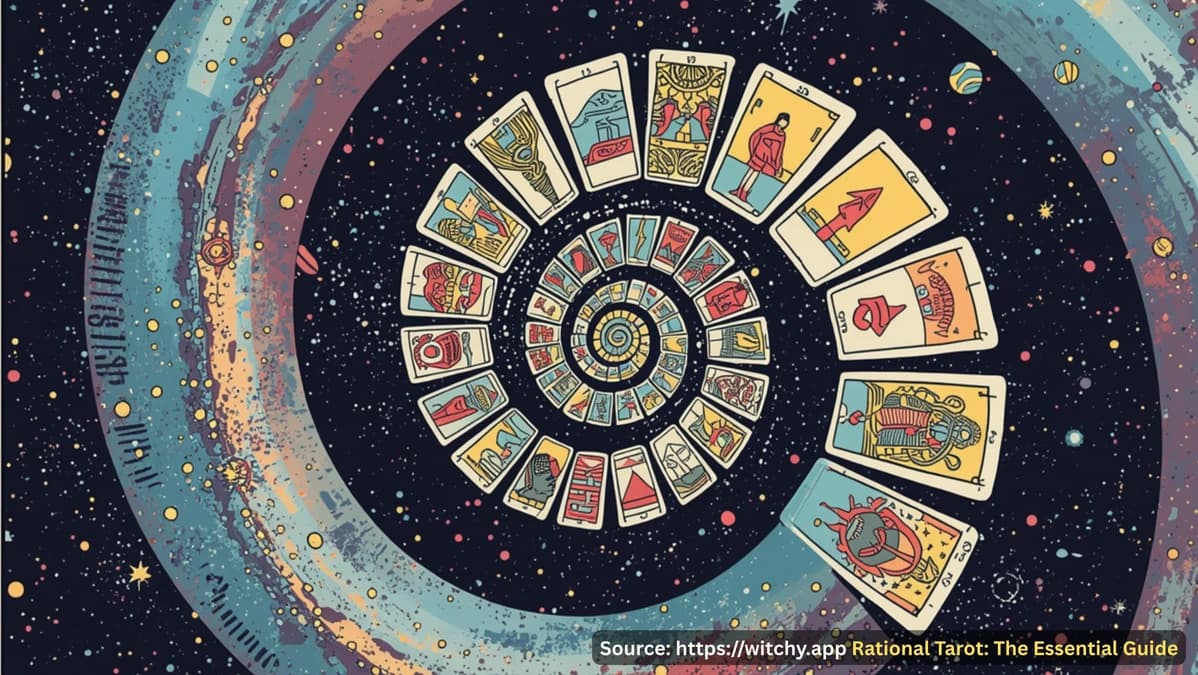
Think about a three-card spread. You aren't just picking three images. You are selecting a specific path through that massive number of arrangements. The order matters. The Magician followed by the Tower is a different data point than the Tower followed by the Magician. Each position changes the meaning. This is why no two readings are ever identical. Even with a small number of cards, the permutations explode. If you draw just five cards, you have over 2.4 billion possible combinations. The math creates a mirror that is always unique to the moment. When we treat the deck as a mathematical space, we stop looking for 'magic' and start looking at probability. The deck is a random number generator with a visual interface. It provides a prompt, but the math ensures that the prompt is always fresh.
Permutations vs. combinations
In math, order matters. If you draw the Three of Swords followed by the Sun, it's a different experience than drawing the Sun followed by the Three of Swords. This is a permutation. A permutation cares about the sequence. In a tarot reading, the sequence often mirrors the timeline of a story: beginning, middle, and end.
Combinations are different. A combination is just a group. If you pull three cards for a 'general vibe' and lay them out in a pile, you're dealing with a combination. The order doesn't change the set of symbols you're analyzing. You're looking at a cluster of themes rather than a linear narrative. Most readers mix these two concepts without realizing it. They use a combination to gather themes, then apply a permutation to create a story. Understanding this distinction helps you realize when you're forcing a narrative and when the sequence is actually providing new data. Think of it like a sentence. The words are your combination. The order of those words is your permutation. 'The dog bit the man' and 'The man bit the dog' use the same combination of words, but the permutation changes the entire meaning. Tarot works the same way. Consider a three-card spread for a relationship. A combination tells you the energy: Passion, Conflict, and Stability. No matter how they land, those three elements are present. But the permutation tells you the trajectory. Passion leading to Conflict is a warning. Conflict leading to Stability is a victory. The cards are the same, but the direction changes the advice. This is why layout matters. A Celtic Cross uses permutations to assign specific roles to cards. A daily pull is often just a combination. When you know which one you are using, you stop guessing and start reading.
Spreads as information structures
A spread isn't a magical ritual. It's a framework for organizing information. Without a spread, you just have a pile of cards. With a spread, you have a coordinate system. You assign a specific meaning to a specific position, which limits the noise and focuses the signal.
Consider a simple three-card spread: Past, Present, Future. This structure acts as a filter. It forces you to categorize the random data of the shuffle into a chronological narrative. By assigning a 'slot' to each card, you reduce the entropy of the reading. You're turning raw randomness into a structured data set. More complex spreads, like the Celtic Cross, create a denser information map. They provide more slots for nuance, such as 'hidden influences' or 'external pressures.'
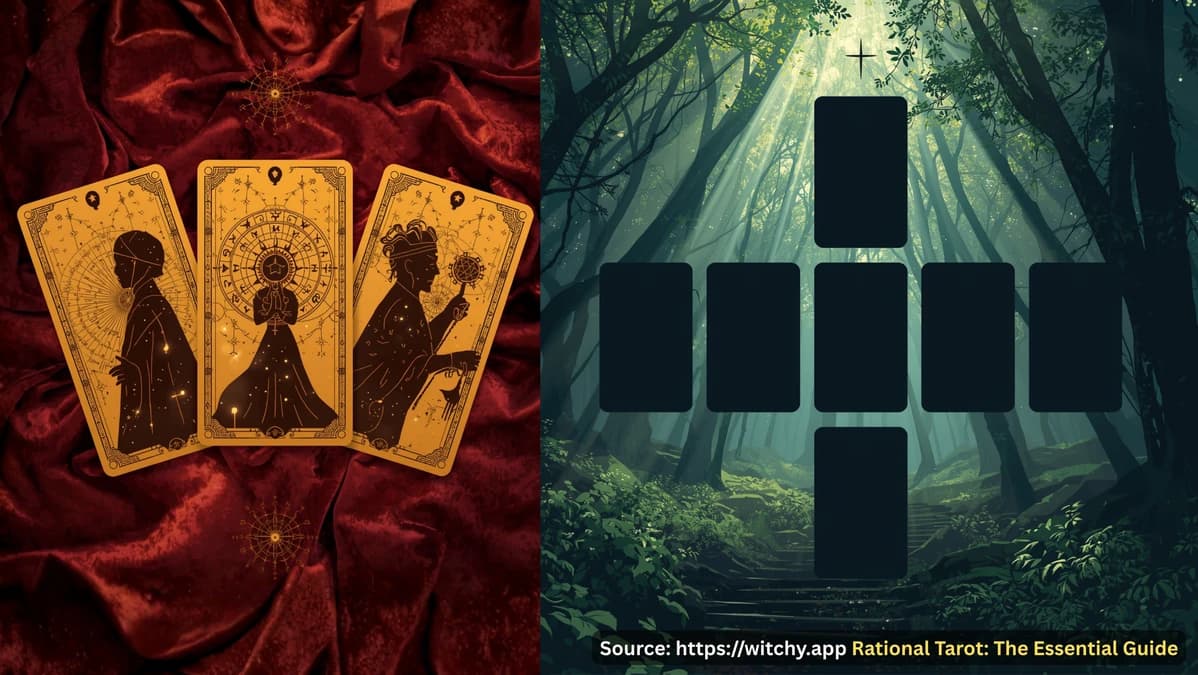
Think of a spread as a question with a built-in answer key. If you pull a card for "Current Obstacle," the card's meaning is instantly modified by that position. The Three of Swords usually means heartbreak. In the "Obstacle" slot, it means a specific grief is blocking your progress. The position does the heavy lifting. Historically, early readers used simple layouts to avoid confusion. They knew that too many cards muddied the water. They focused on the relationship between cards rather than just the individual meanings. This is called synthesis. You aren't just reading a list; you are reading a map. However, more cards don't always mean more clarity. In information theory, adding too many variables can lead to 'overfitting.' This happens when you have so many cards that you can find a way to justify any answer you want. The best spreads balance enough data to be useful without so much that the meaning dissolves into noise.
Randomness, coincidence, and meaning
How does a random shuffle produce a meaningful answer? The answer lies in a psychological phenomenon called apophenia. This is the human tendency to perceive meaningful patterns within random data. We are evolved to see patterns; it's how our ancestors survived. If we saw a pattern in the grass that looked like a tiger, it was safer to run than to wait for a mathematical proof. Tarot uses this cognitive bias. The cards provide a random stimulus—a picture of a tower falling or a woman with two cups. Your brain then scans your current life experiences to find a match for that image. You aren't predicting the future; you're using a random prompt to trigger a subconscious association.
This is closely related to the concept of synchronicity, coined by Carl Jung. Jung described synchronicity as meaningful coincidences. From a rational perspective, these aren't supernatural events. They're the result of a high-probability environment where your brain is actively searching for relevance. Think of it like a Rorschach inkblot test. The ink is just a smudge. The meaning comes from the viewer. If you draw the Three of Swords while grieving, you don't need a psychic to tell you the card represents heartbreak. Your brain connects the image of a pierced heart to your own pain instantly. The card acts as a mirror, not a map. When you accept that the cards are random, you actually gain more power. You stop being a passive recipient of a message and start being an active analyst. You use the math of the deck to break your own mental loops. The randomness is the tool that forces you to think about your problem from an angle you would have ignored if you were just thinking in circles.
Try it
Sources
- Jung, C. G. (1952). Synchronicity: An Acausal Connecting Principle.
- Bayer, D., & Diaconis, P. (1992). Trailing the dovetail shuffle to its lair. Annals of Applied Probability, 2(2), 294-313.
- Aldous, D., & Diaconis, P. (1986). Shuffling cards and stopping times. American Mathematical Monthly, 93(5), 333-348.
- Shannon, C. E. (1948). A mathematical theory of communication. Bell System Technical Journal, 27(3), 379-423.