
Chapter 5
How to Read the Cards
Major Arcana, Minor Arcana, reversals, spreads, and daily practice.
Major Arcana: the soul's journey
The Major Arcana consists of 22 cards. Think of these as the 'big' themes. They don't deal with your laundry or your boss's mood. Instead, they focus on archetypes. These are universal patterns of human experience. When a Major Arcana card appears, pay attention. It means a significant shift is happening or a major lesson is at play.
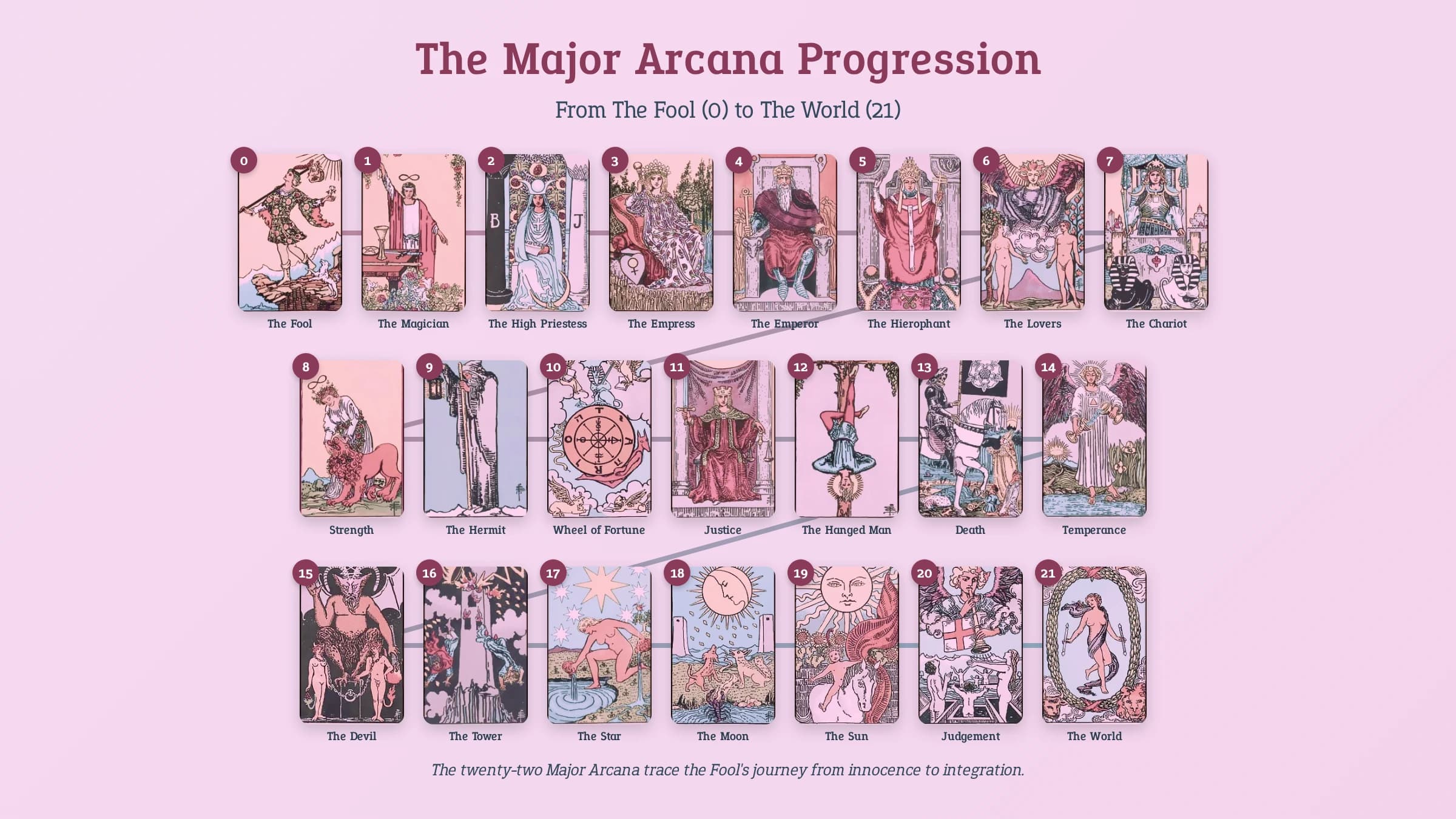
Start with The Fool. He's the zero point. He represents pure potential and the leap of faith. From there, the cards follow a sequence known as 'The Fool's Journey.' You move through the external world of authority and social structures, then dive into the internal world of psychology and spirit. It's a map of growing up. You encounter the Father, the Mother, the Lover, and eventually, the void of the Tower. In a rational reading, don't treat these as fate. They aren't telling you what will happen. They're describing the psychological state you're currently in. If you pull The Emperor, you aren't necessarily meeting a bossy man. You might be struggling with your own need for control. You're looking at a mirror of your subconscious. Use these cards to identify the overarching narrative of your life right now. Ask yourself: Which archetype am I embodying today? Am I the High Priestess, trusting my gut, or am I the Hermit, needing a break from the noise? By naming the pattern, you gain power over it. You stop reacting to life and start observing it. This is where the 'rational' part of Rational Tarot begins. We use symbols to categorize our emotions so we can manage them better.
Minor Arcana: the four suits of daily life
The Minor Arcana handles the grit and grime of everyday existence. There are 56 cards divided into four suits. Each suit links to a specific area of your life and a classical element. Wands are fire. They're about passion, drive, and ambition. When you see Wands, think about your energy levels. Are you burnt out or fired up?
Cups are water. They govern emotions, relationships, and intuition. These cards track how you feel and how you connect with others. Pentacles are earth. They deal with the physical world: money, health, and home. If you're worried about your bank account or your diet, Pentacles will show up. Swords are air. They represent the mind, conflict, and communication. Swords are often the 'sharp' cards because logic can cut through emotion, but it can also wound. Each suit has numbered cards from Ace to Ten, plus four court cards. The Ace is the seed. It's a new spark of energy. The Ten is the completion or the extreme. For example, the Ten of Swords isn't just a bad day; it's hitting rock bottom. The court cards—Pages, Knights, Queens, and Kings—usually represent people or specific personality traits. A Page is a student; a King is a master.
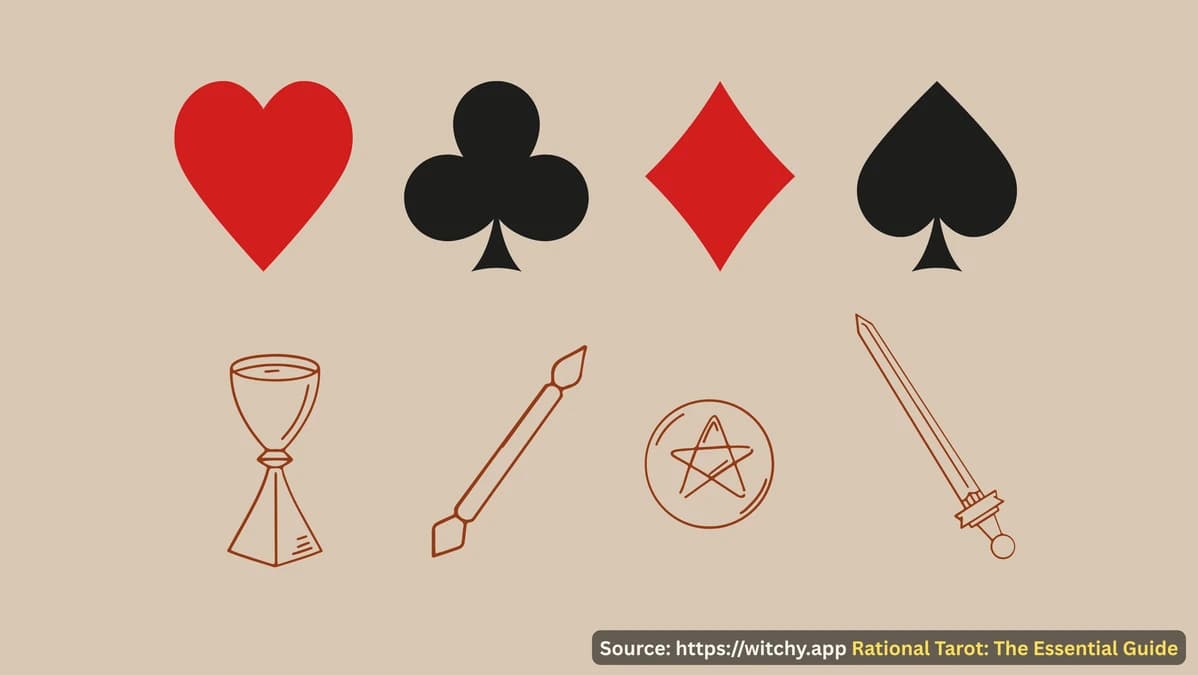
To read these, look for the dominant suit in your spread. If your reading is full of Swords, you're overthinking. If it's all Pentacles, you're too focused on the material. The Minor Arcana provides the context for the Major Arcana. While the Major cards tell you the 'why,' the Minor cards tell you the 'how' and the 'what.' They bring the high-level archetypes down to earth.
Pentacles
Wands
Swords
Upright and reversed: the turn of the mirror
Some readers ignore reversals. They think a card means the same thing regardless of which way it points. Rational Tarot takes a different approach. A reversal isn't necessarily 'bad' or 'opposite.' Instead, think of it as internal energy. An upright card is an external expression. A reversed card is an internal process.
Take the Three of Wands. Upright, it's about expansion and looking toward the horizon. You're planning a trip or starting a business. Reversed, that same energy turns inward. You're planning in your head, but you haven't taken the first step. You're dreaming, but you're stuck in the preparation phase. The energy is there, but it's blocked or redirected. Reversals can also signal a need for caution. If a positive card appears reversed, it might mean the energy is being misused. The Sun is joy and success. Reversed, it might mean you're ignoring the truth or clinging to a false optimism. It's a nudge to look closer. It asks you to find the shadow side of the card's meaning. Don't let reversals intimidate you. They add nuance. They turn a flat image into a 3D experience. When you see a reversed card, ask: 'Where is this energy trapped?' or 'How am I keeping this from myself?' This turns the reading into a psychological investigation. You're not predicting a reversal of fortune; you're identifying a reversal of perspective.
Spreads: mapping the inner landscape
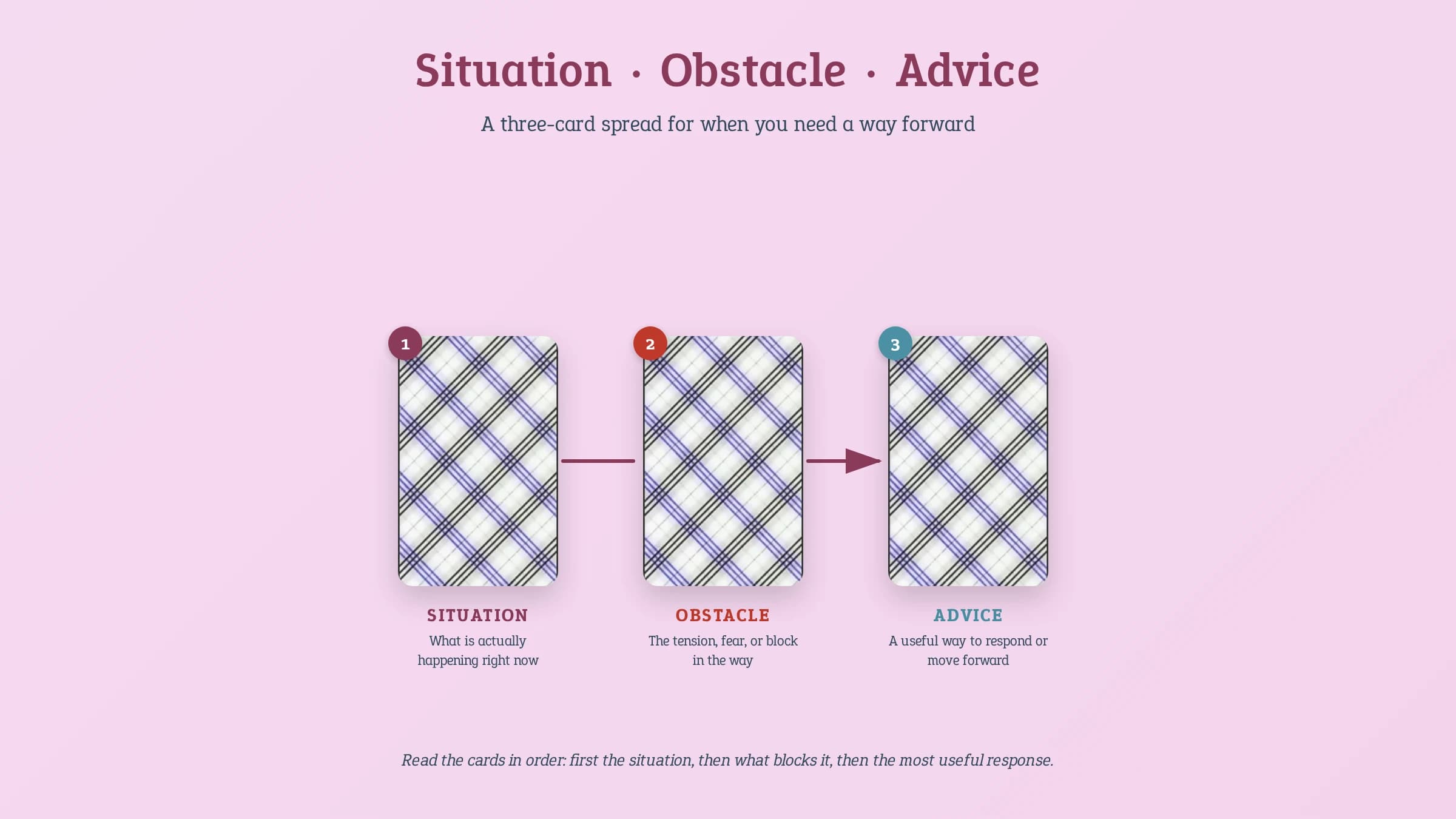
A spread is just a template. It gives your cards a job. Without a spread, you're just looking at a pile of pictures. With a spread, you're building a sentence. The most basic spread is the single card. This is perfect for a daily check-in. You pull one card and ask, 'What should I focus on today?' It's a simple, direct way to prime your brain for the day. The Three-Card Spread is the workhorse of tarot. It's flexible. Most people use it for Past, Present, and Future. But in Rational Tarot, we prefer more active frameworks. Try 'Situation, Obstacle, Advice.' This moves the reading from a prediction to a problem-solving session. Instead of wondering what will happen, you're figuring out how to handle what is happening.
For deeper work, you can use the Celtic Cross. It's a complex layout that examines the root of a problem, your conscious thoughts, and the likely outcome if things stay the same. It's like a mental audit. It forces you to look at the variables you've been ignoring. You see the external pressures and the internal conflicts all in one glance. Remember that you can make up your own spreads. If you're struggling with a relationship, pull two cards for the partners and one for the dynamic between them. If you're planning a project, pull cards for the Goal, the Risk, and the First Step. The spread is a tool for organization. It keeps your intuition from wandering and keeps your logic engaged.
Building a personal relationship with the deck
You don't learn tarot by memorizing a guidebook. You learn it by living with the cards. A guidebook gives you a definition, but your experience gives you a meaning. The goal is to move from 'What does this card mean?' to 'What does this card mean *to me*?' This is how you build a rational, personal system of symbols. Start a tarot journal. Every morning, pull a card. Write down the traditional meaning. Then, write down what you think it means for your specific day. At the end of the day, look back. Did the card show up in a way you expected? Did it highlight a mood you were ignoring? This creates a data set. You'll start to notice that every time you pull the Seven of Swords, you're feeling anxious about a secret. That's your personal shorthand. Spend time with the art. Lay out the cards and just look at them. Notice the colors. Notice the expressions on the faces. Why is the figure in the Eight of Swords blindfolded? Why is the background of the Nine of Cups a specific color? The images are designed to trigger your subconscious. Let your eyes wander. Your brain will make connections that a textbook can't provide. Treat your deck like a tool, not a magic wand. It's a deck of cards, not a crystal ball. The power isn't in the cardboard; it's in your ability to synthesize symbols and apply them to your life. The more you practice, the more the cards become a language. Eventually, you won't need the book. You'll just see the image and know exactly which part of your psyche is speaking.